by D. Patrick Miller

Two or three times a week I’m on the floor of my gym doing a set of exercises that includes a two-minute pattern of twisty-turny leg lifts, designed to strengthen the muscles that surround and support my knees. I was taught these techniques by an orthopedist in San Francisco almost fifty years ago, after my knees had taken a beating from a few months working as a bicycle messenger. And that was after I had completed a 3200-mile cross-country bicycle odyssey from my homeland of North Carolina to California.
The far more arduous ordeal of pedaling a heavy, cumbersome freight bike in the hazardous traffic of downtown San Francisco had caused fluid to build up around my knees. The orthopedist felt all around them, said “Hmm…” and then asked me to try to grasp one ankle from behind, pulling the heel up to the thigh — which I could do, if uncomfortably.
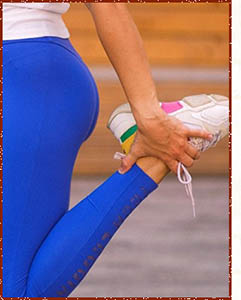 “See, there’s the problem,” the doctor observed. “Your kneecaps are hypermobile, more like a woman than a man.” He stood up, tried the ankle grab himself, and couldn’t get his foot up behind him much higher than the level of his knee. He was stocky so I wasn’t surprised — and I was skeptical of the gender diagnosis — but he continued with gusto:
“You see, most men are too muscular to make that reach from behind. You’ve got a flexible, feminine build that makes your knees more susceptible to stress.” He bloviated for a while about male and female differences in power and flexibility, so proud of his masculine minerality that I had to stifle a chuckle about the unsolicited man-lecturing. (A few years later I would share his diagnosis with my chiropractor, thin and lightly built himself, who made the ankle grab from behind easily. His diagnosis? “Bullshit. That’s not a gender-related difference, it’s a matter of individual physique.”)
Regardless, the macho orthopedist ended our consultation by teaching me the set of knee exercises that I have continued to practice to this day. This is certainly the oldest single bit of practical wisdom that I was ever taught.
About three weeks after that, I heard a radio news report of a single-engine plane crash over the East Bay hills above Berkeley. By the next morning the crash was in the newspaper, and the deceased solo pilot was identified as my orthopedist. The story reported that he’d driven to a small regional airport where he kept his plane, showing up in the lobby sneezing and sniffling. The lone person working the desk in the airport reminded him of the FAA caution for solo pilots to “self-evaluate” their health condition before flying, especially in light of the possibility that a sinus condition could lead to blacking out while airborne. My good doctor reportedly dismissed the warning — I could just see his macho shrug in my mind — and soon paid the ultimate price. A number of people had reported seeing the plane flying normally in a straight line at a low altitude, then suddenly nose-diving to the ground.
 Lying on the gym floor recently, I was dutifully doing my knee lifts when I started to think about the comparative wisdom of all my teachers in this lifetime. Not long
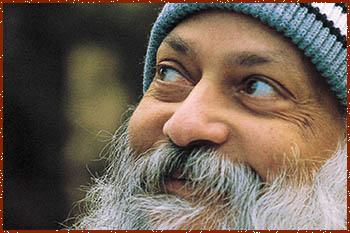
after the Dr. Manly episode, I encountered the published discourses of Bhagwan Shree Rajneesh, an immigrant Indian “godman” who was making waves in various hip urban centers in the US, including the San Francisco Bay area. I read four or five volumes of his talks and was quite taken with the teachings — that is, until a group of his followers in my neighborhood began making themselves into social pariahs.
Lying on the gym floor recently, I was dutifully doing my knee lifts when I started to think about the comparative wisdom of all my teachers in this lifetime. Not long
after the Dr. Manly episode, I encountered the published discourses of Bhagwan Shree Rajneesh, an immigrant Indian “godman” who was making waves in various hip urban centers in the US, including the San Francisco Bay area. I read four or five volumes of his talks and was quite taken with the teachings — that is, until a group of his followers in my neighborhood began making themselves into social pariahs.
Rajneesh taught a weird amalgam of Eastern detachment and Western self-indulgence, in which you were supposed to stay philosophically aloof from the world while doing whatever-the-hell-you-felt-like within it. He’d gotten himself bounced from India for tax problems and generally annoying the government there, while also committing the cultural offense of dressing his throngs of affluent Western followers in the traditional orange garb of ascetic sannyasins.
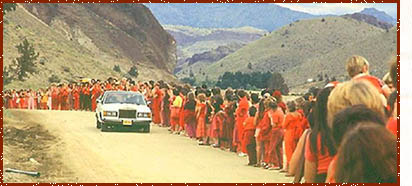
In the US cities where he was popular, Rajneeshees were easy to spot. Not only did they all wear garish shades of maroon and orange, but they also flaunted no-smoking ordinances, behaved rudely in restaurants, made out in public, and offended public decency in general. After meeting a few of them, the rose of the Rajneesh wisdom definitely wilted for me, because it was clear that applying his philosophy resulted in social misbehaviors. Little did I know how bad it would get.
 By 1981, Rajneesh had settled with many of his followers at the Oregon
retreat called Rajneeshpuram, where the guru relaxed between discourses and shakti dispensations by tooling around in his 93 Rolls-Royces, waving to throngs of orange-clad disciples. The cult incorporated itself as a city, and then the guru’s chief lieutenants began making brazen moves to consolidate regional political power near the tiny, beleaguered village of Antelope. Beginning with voter fraud, these machinations culminated in mass poisoning and assassination plots in which the Bhagwan’s complicity was murky. He was either a dissociated sociopath or the worst city manager imaginable. The end result was his attempted flight from US immigration charges in 1985. Forced to land his two Learjets for refueling in Charlotte, NC
By 1981, Rajneesh had settled with many of his followers at the Oregon
retreat called Rajneeshpuram, where the guru relaxed between discourses and shakti dispensations by tooling around in his 93 Rolls-Royces, waving to throngs of orange-clad disciples. The cult incorporated itself as a city, and then the guru’s chief lieutenants began making brazen moves to consolidate regional political power near the tiny, beleaguered village of Antelope. Beginning with voter fraud, these machinations culminated in mass poisoning and assassination plots in which the Bhagwan’s complicity was murky. He was either a dissociated sociopath or the worst city manager imaginable. The end result was his attempted flight from US immigration charges in 1985. Forced to land his two Learjets for refueling in Charlotte, NC — my place of birth — the guru was caught at the airport by the FBI. An art professor at my alma mater, UNC-Charlotte, made a small fortune selling t-shirts with the legend WE BHAGGED
THE BHAGWAN (a version of which is still for sale today).
— my place of birth — the guru was caught at the airport by the FBI. An art professor at my alma mater, UNC-Charlotte, made a small fortune selling t-shirts with the legend WE BHAGGED
THE BHAGWAN (a version of which is still for sale today).
Rajneesh finally made a deportation deal with the feds and fled the US for good, trying to alight in a number of countries that rejected him before ultimately resettling in Pune, India and expiring at age 58 in 1990. Today he’s still venerated by many as ‘Osho’, and his wisdom legacy remains available in teaching centers and scores of published volumes. I had sheepishly gotten rid of all his books well before he was bhagged by my hometown, but I still wonder sometimes: After all the Rajneesh stuff that I read for a couple years, how much got deeply ingrained, for good and/or ill, in my consciousness? I will never know for sure.
But I would be a fool not to take any bit of wisdom wherever I can find it.
And then there was the time I almost joined a cult...

_____________________________________
You can support the writing of feature stories like this one...
First trained as an investigative journalist, D. PATRICK MILLER began writing about spirituality, human potential, and creativity after a seven-year illness initiated his spiritual path. Since that time he has intensively studied A Course in Miracles, the Enneagram system of personality, Jungian depth psychology, shamanism, and related fields of contemporary spirituality. He has also applied spiritual principles and disciplines intensively in his own life, and written about the results. He is the author of a dozen print titles and many more e-books. As a magazine and online journalist, Patrick has written over 200 articles for Yoga Journal, THE SUN, Elephant Journal online, and this website. He is also the founder of Fearless Books and Literary Services. For information about his coaching service on a variety of topics, see Consulting.
