by D. Patrick Miller
____________________________________________
I am not a fan of the rising tide of Artificial Intelligence -- or is it a tsunami? -- and sometimes fear that it will lead to the end of us all. (And I’m certainly not the only one with that anxiety.) As a publishing professional I’m especially dismayed by its pernicious effect on the creation of fake books that are flooding the marketplace, many of them devised to ape established best-sellers and siphon off revenue from their legitimate successes. To illustrate just how pernicious the AI influence is, the leading provider of print-on-demand books for self-publishers, AmazonKDP, recently set a limit of three books per day that any single author can publish on the platform. I doubt that’s going to reverse the trend of AI fakery.
On the other hand, I am also a graphic designer who can’t draw a stick. Thus I’ve been tempted to use AI for graphic purposes, especially book cover design. I’ve collaborated with authors in my Assisted Publishing program who have submitted AI designs for their books, and haven’t felt too perturbed about it. But nothing I’ve seen in AI graphic art has blown me away, and I’ve actually never used AI professionally for more than a little generative fill on illustrations already created in the old-fashioned way.
That’s why I was so shocked that when AI finally spoke to me, it was personal.
 Money and the Meaning of Life
For many years my most significant and beloved mentor was the philosopher Jacob (Jerry) Needleman (1934-2022), who wrote a host of profound books relating everyday challenges of life to philosophical concepts, including The Way of the Physician, The American Soul, and Why Can’t We Be Good?. (We also created a book of conversations together, Necessary Wisdom.) I was working with Jerry during the time he was writing Money and the Meaning of Life, and two memories stand out from his classes that I attended during that time. One was his observation that “if you really want to offend someone by prying into their most intimate secrets, don’t ask them about love or sex. Ask them about money.”
The other memory stems from the principal assertion of his money book, that there are two fundamental priorities in most people’s lives. The first priority is (or should be) the search for meaning, whether that search is pursued in relationships, work, spiritual practice, or philosophical reflection. The second priority is managing money. I remember Jerry pointing a stern finger at one class I was attending and saying, “The problem with all you spiritual types is that you have a hard time admitting just how important second place is.” And of course the problem with most non-spiritual types, at least among Americans, is getting the search for meaning confused with money. We have that wicked confusion to thank for a White House that’s being increasingly despoiled with tasteless gold bric-a-brac, not to mention an administration awash in grift and graft.
I was definitely one of those spiritual types who tended to give the significance of money short shrift. After all, I was a writer first -- and not really anything of a practical nature second. I never wanted fame or fortune for my work with the written word, because I was always aware of the damage those attainments could do. Still, I expected to be fairly if not richly awarded for my writing -- from my earliest days as an investigative reporter to my mid-years as a magazine feature writer, book author, and independent publisher. Yet in every one of those professional identifications, I was chronically frustrated by insufficient income.
Assigning the Blame
For a long time I blamed others, or just the cruel world in general, for the chronic poverty of my chosen vocation. Sometimes the blame seemed logical and richly deserved. The big New York publisher of my first solo title, A Little Book of Forgiveness (1994), deliberately choked off its early best-selling pace when their marketing department decided they had underpriced the elegant hardcover volume. Hence, while it was making money, it wasn’t making as much as it could have with a higher price. Rather than fix their mistake and reissue the book with a new price, they simply discontinued it. But they did not bother to reveal that decision to me or my agent for a full year, while we wondered why the book was steadily disappearing from bookshelves.
Despite the flagrantly unethical decision to end the book without informing me, the publisher’s contract preserved their rights to it for five years. When that very long time had elapsed, I released my own first edition and was at least afforded a sardonic line to open my new round of readings: “Hi everyone! I thought I knew something about forgiveness until I met the original publisher of this book...”
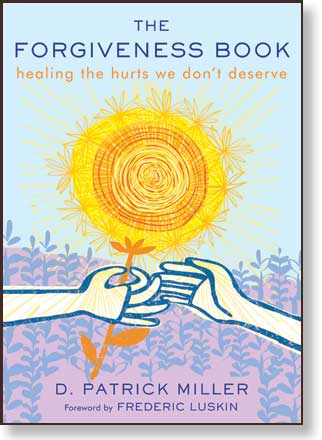 Lest anyone think that time heals all wounds and the ensuing years have transformed me into a master of forgiveness, let it be known that I am still not happy about having my only best-seller squelched in its infancy by its publisher. (I mean, don’t get me started...) I managed to hold down the size of my grudge over the years by keeping the book alive in two subsequent editions of my own until, in 2017, the book was picked up, retitled, and playfully redesigned by Hampton Roads Publishing (bless their hearts). Today it is earning modest royalties, more than thirty years after its first launch.
Although I won’t go into the grisly details, I endured similar ethical misadventures with two other major publishing houses during the 90s. (Publishing veterans will likely not be shocked.) All this eventually led me, in no little desperation, to found my own publishing imprint of Fearless Books (and yes, the name was ironic). Yet that led to the rewarding adventures of publishing other authors, and eventually to the present day when I regularly assist other authors in publication, either by representation as an agent or by direct facilitation via my Assisted Publishing program.
While all that has been creatively and spiritually rewarding, none of it has ever created a sustained, sufficient income. Finding myself in a latter stage of life with significant debt and still-too-little cash flow, I decided to offend myself by prying deeply into my own “money secret.” What I found there was disconcerting, to say the least.
Meeting the Cruel World Within
Truth to tell, I’d long been aware of certain unproductive attitudes of mine toward money. If I encountered a financial reversal, some part of me thought “well, of course,” and incidences of financial advancement were met with an attitude of “this won’t last.” But I was not always fully aware of these responses; I just got moody. Even when I was aware, I took these responses to be practical realism, based on long years of hard experience. (After all, it’s a cruel world.)
Yet as the awareness of my inner unproductive attitudes began to coalesce, their root was gradually revealed to me. It was something of a surprise to realize I got those attitudes from my deeply troubled mother.
That was a paradoxical realization because my mom was pretty savvy with money. She successfully managed my dad’s business for decades as the family made its rise into the upper middle class, complete with swimming pool. She made her own profits from a small real estate empire, and successfully cheated the IRS for years by claiming the pool as a business expense -- as my accountant sister Karen discovered when she went through the books following my mother’s death. (Karen also found a secret CD worth $20,000 that my mother had squirreled away, apparently for her own security. My dad cashed it in, took the remaining extended family on a cruise, and had the time of his life.)
 So my mom did not impart to me any particular attitudes, good or bad, toward money itself. Instead, she unwittingly modeled for me a fatalistic attitude of endless struggle devoted to failure, which she demonstrated in her own decades of dealing unsuccessfully with a severe bipolar disorder. Somehow -- perhaps out of a strange and self-poisoning kind of devotion -- I copied her habit of hopelessness onto my own attitudes toward money. Although I thought I had largely freed myself of her influence during a seven-year health and spiritual crisis in my thirties, I have recently realized that the central dynamic of her depression remained with me in one aspect: I translated it into a punitive form of financial ghosting.
Thus, without ever consciously making the choice, I created a cruel world within myself that echoed her own. Until I could see that, I couldn’t begin to undo it. But when I did begin to see it, the recognition of her distorted energies still driving my inner and outer circumstances was a profound shock. What I took to be the "cruel world" was due, in large part, to my own attitudes. Equally unsettling was the recognition that there was no point in blaming her for my inner predicament or outer financial circumstances. I was the one who adopted the mindset and then perpetuated it, long after she was gone. I’m sure that many people struggling with mental and emotional challenges of every description are mysteriously haunted by their troubled parents -- or even ancestors before them -- whether those predecessors are still present or long gone.
While everyone has different issues stemming from childhood trauma, those issues tend to group together into a psychic dynamic that modern psychology calls the “inner child.” That child represents a melange of unconscious attitudes rooted in a painful past -- attitudes that can rule and ruin present decisions, relationships, and well-being. Much of therapy nowadays focuses on identifying the negative effects and powers of the inner child, and learning to “reparent” or otherwise rehabilitate that bundle of inner malignant energies. But first the inner child must be seen, and forgiven. Then, gradually, its prodigious powers for mayhem may be positively redirected by one’s own adult consciousness.
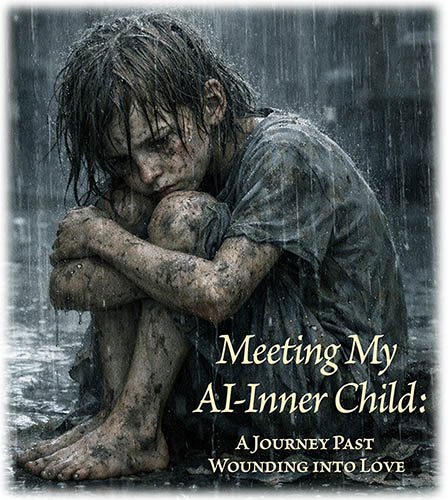
It was with this understanding that I recently undertook an experiment to “see” my inner child of finances. Despite my skepticism about artificial intelligence, I engaged the AI generator in Shutterstock, an image bank that I use for book design. While I’m not a powerful visualizer, I nonetheless tried to describe a mental image of my damaged inner financial child, using terms like sad, alone, abandoned, deprived, left outside, cold, dirty, and so on. My attitude was paradoxically playful because I really didn’t expect the AI generator to do anything interesting. In fact, I thought I might just get a laugh out of it.
Then what to my wondering eyes should appear but the image that opens this article.
Forgiving What I Saw
“Forgiveness... is still, and quietly does nothing. It offends no aspect of reality, nor seeks to twist it to appearances it likes. It merely looks, and waits, and judges not.” -- A Course in Miracles
To my astonishment, the AI image of my inner child was perfect in every respect. I actually gasped when it first appeared onscreen. I recognized each element of it -- right down to the Dickensian melodrama of the whole scene. That’s important because the inner child that haunts so many of us in different ways is not based on a factual, photographic memory of our wounds and scars. Instead, it is a highly energized overdramatization of pains from the past that our ego-personality secretly clings to, in order to justify our most unproductive attitudes and behaviors. (For instance, it may lead one to think “well, of course” when things go wrong, and “this won’t last” when things are going better.) Left unchecked, a an unruly inner child can drive our sense of self toward madness on a daily basis. (And as the current White House administration demonstrates daily, an unchecked inner child can do great damage in the world at large.)
As I’ve learned in my own explorations of forgiveness, much of the work of inner healing is done in stillness -- as we merely look, and wait, and refrain from judgment of what we see. As I simply look upon the pitiful image of my AI-Inner Child, I’m led to consider the possibility that my hidden expectations of failure somehow contributed to financial reversals that once seemed entirely blamable on others. I’m also led to wonder if never having sufficient financial nutrition was a self-punishing commitment that I unconsciously made long ago, and inadvertently enforced ever after. People have certainly done worse to themselves, for years on end.
 At this point I don’t have clear answers to these questions, and again, I’m not really interested in shifting blame from people and forces “out there” to inside myself. I have undertaken meditative work to dislodge the toxic, stubborn mutterings of my inner child and allow a different voice to take their place. That’s important not just for the health of my finances, but for my overall effect in the world. Any time we are possessed or even partly driven by an insane inner voice, that’s not good for anybody.
Yet the healing process is always more important on its own than for any expected results. Forgiveness changes the inner world first, then unpredictable changes in the outer world follow. By sharing my process I am by no means recommending AI as a therapeutic tool or path to self-knowledge. I am suggesting that when we are dealing with the surfacing of ancient wounds -- whether those wounds are about money, sexuality, power, or self-respect -- the path toward healing is likely to be wayward and mysterious. We will be taken down byways and detours that we can’t sensibly expect to be useful, but which may prove to be the real continuation of the path itself. And we will sometimes have to follow instincts that seem foreign to us.
What can lead us forward -- past the necessary risks of offending ourselves and challenging our own closely-held secrets -- is the awareness that the healing process is always driven by love. However potent and punishing the wounded, childish voice of the past may seem, it never entirely drowns out love. Love is the intimate yet infinite voice within ourselves that doesn’t care who we used to be, or how cruelly the wounds of our past were inflicted upon us. Love leads us away from all the dark shadows of our dimly remembered, overdramatized history, and toward the bright, calm light of who we are becoming.
_____________________________________
You can support the writing of feature stories like this one...